
BEWARE OF WHAT WE WATCH

Matthew 6:22-23 (KJV) The light of the body is the eye: if therefore thine eye be single, thy whole body shall be full of light.
But if thine eye be evil, thy whole body shall be full of darkness. If therefore the light that is in thee be darkness, how great is that darkness!

This is true in both the physical and spiritual realm, but the Lord Jesus is speaking of spiritual matters. The subject is the same as before – treasures. To fix the eye on something is to desire it. Good spiritual eyes see things as they are and desire the glory of God, the things of the kingdom of light, and the eternal rewards He gives to those who serve Him. Bad spiritual eyes do not see things as they really are, and desire the things of time, the things related to sin, self, and darkness. They see no glory of Christ and no value in salvation.

The direction in which the eyes of our mind and heart look determines whether we will be filled with God’s light or the darkness of sin. There are only two possible kinds of vision – that which is set on the things of this world, or that which is set on the things of heaven. God will hold us responsible for where we keep our eyes.

What we see has such a great impact on our inner being. And what we choose to look at, even more so. When our eyes feed our lust and greed, the darkness of envy grows within us. But when we look with wonder at God’s handiwork, or with compassion on God’s children, His light fills us and radiates from us.
BLESSED ARE THEY WHO HAVE NOT SEEN AND BELIEVE

John 20:28-29 (KJV) And Thomas answered and said unto him, My Lord and my God.
Jesus saith unto him, Thomas, because thou hast seen me, thou hast believed: blessed are they that have not seen, and yet have believed.

20:28 God turns His people’s failures to some good. Because of the doubts of Thomas, and Christ’s revealing Himself to him, we have this great expression of faith. Thomas, as a Jew instructed in the Old Testament, and taught by Jesus Himself for three years, knew very well that there was only one God and that to have any other god was the worst of sins. When he called Jesus “Lord” and “God” he was expressing his conviction that Jesus was the incarnation of the one true God, of the Old Testament.

20:29 See how the Lord Jesus accepts his words. In other words, He agrees with Thomas that He is Lord and God. If Jesus did not know He is Lord and God it is inconceivable that He would have done this. Mere men, if they are good men, do not accept divine honors.

“Blessed”– this blessing comes on all of us today who believe as Thomas did – that Jesus rose from the dead and that He is Lord and true God and that He is that to us. The opposite is also true – God cannot pronounce His blessing on those who do not believe this.

Just like Thomas, we have our moments of doubt. And like Thomas, sometimes the Lord supplies us with the proof that we demand. And sometimes, we must trust by faith. But when we struggle with doubt, Jesus is faithful to answer us, to answer our doubts, and to increase our faith.

LIGHT OF LIFE

John 8:12 (KJV) Then spake Jesus again unto them, saying, I am the light of the world: he that followeth me shall not walk in darkness, but shall have the light of life.

“Light” Jesus is the light God has given for the whole world. What the sun is to the physical earth that’s what Jesus is to the world of men. His life, His deeds, and His words reveal the truth about God and men and salvation and what God does and what men should do. This light reveals the difference between the real and the unreal, the true and the false. It shows the way to heaven.

But this light will be effective only for those who follow Christ (the Greek word indicates continuous following). Following means trusting and obeying. If we shrink back from Him we will remain in darkness and ignorance about the most important things of life. The followers of Jesus are in the light now and will see many truths they could not see otherwise, and they know where they are going. Unbelievers are in the dark now (and so all they can do is deny the light and speculate about spiritual things), and, if they do not repent and turn to the light, will go into eternal darkness.

The phrase “light of life” may mean light which is life, or which gives life, or which comes from life, or which shines on life, or perhaps all of them. Here is a question of great importance: Do we really want the light that Christ gives, or are we content with our darkness?

We try to control every inch of our lives is in some sense natural. It is not at all unusual to try and safeguard ourselves from danger and the unknown. The more control we have we feel we might be able to rest from a situation, (or others), the easier our lives will be. But, in matters of the spirit, we are not leaders. We cannot be masters of our fates in the way we wish. Rather, we are followers, we are disciples who need the word and light of the Lord God and His only begotten Son to guide us. No man in front of God is thus a master, for we are all His children, in need of compassion and care.

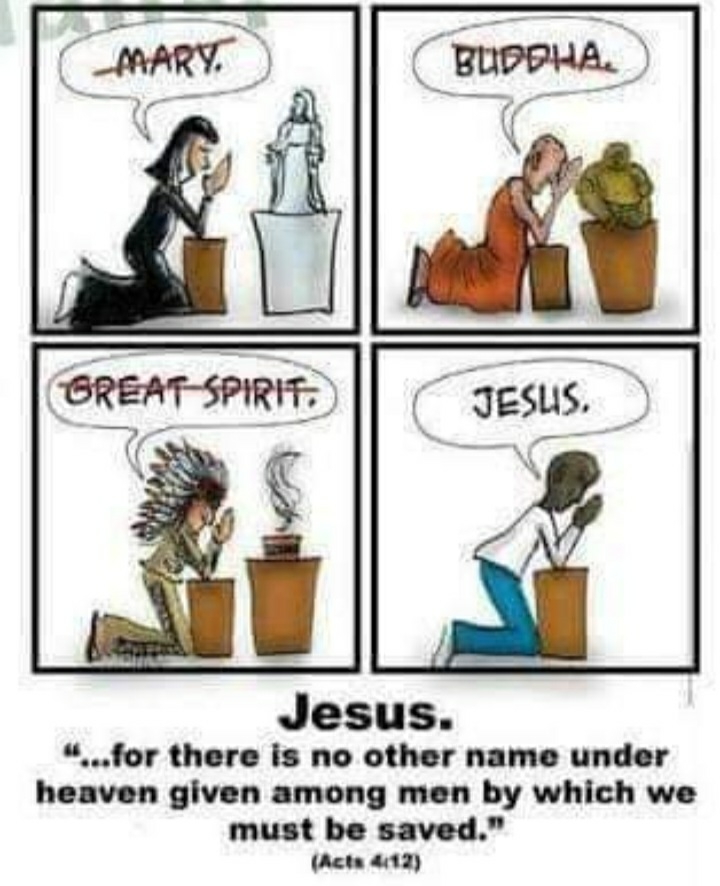
ONLY ON MEDIATOR

1 Timothy 2:5 (KJV) For there is one God, and one mediator between God and men, the man Christ Jesus;

“One God”– In other places Paul taught that Christ is a member of the Godhead . He certainly is not denying that truth here, but speaking of Christ as man, the Word made flesh .

“Mediator”– in the New Testament this word is used only here and in, but the same truth in different words is found everywhere. Because Jesus is both God and man He understands both and can lay His hand on both and be the mediator desired. There is no other person, no saint, no so-called “god” or godman who is a mediator between God and men. And since Jesus is a perfect mediator no other is needed. If all men, even if all who are called Christians, believed this what a difference it would make on earth!

God is infinite and omnipotent. So it is easy for us to think that He is unknowable, unreachable, and elusive. But in Jesus, the unknown is revealed. Through Jesus, the unreachable is in our grasp. We have no need to despair of knowing God, nor do we have any need to search out hidden wisdom or new philosophies. In Jesus, we have all we need to commune with the Father.

THE WEAK IN FAITH

Romans 14:1 (KJV) Him that is weak in the faith receive ye, but not to doubtful disputations.

Here is the general principle Paul teaches. In vs 2-6 he gives two examples of matters which believers may disagree. His purpose is to show that Christians are to be helpers of each other, not judges. Each believer should accept all other believers who are trying to live for Christ.

Believers must judge evil behavior, but not condemn fellow believers who disagree with them about comparatively unimportant matters. Separation from other believers over such matters is utterly wrong. Of course there are fundamental truths of the faith which must be preached and defended even at the cost of separation from other Christians who reject them. But Paul is not speaking of these matters here in this chapter.

One who is “weak in the faith” is one who tends to have a sensitive conscience. They may not have as much knowledge of the freedom we have in Christ as you may. This is common among young believers – people who have just become saved. We are not to castigate them and make them feel ashamed, no. We welcome them and teach them, and encourage them as they grow.

GOD HEARS OUR PRAYERS

Exodus 3:7 (KJV) And the LORD said, I have surely seen the affliction of my people which are in Egypt, and have heard their cry by reason of their taskmasters; for I know their sorrows;

The ancient Israelites were suffering under the oppression of Egypt. But their cries did not go unheard, God saw their situation, heard their pleas, and took action. When we encounter suffering, He sees our needs and hears our cries, too. And we can trust that, even if it takes some time, He is working out a plan for our deliverance just as He did for Israel long ago.

Psalms 34:4 (KJV) I sought the LORD, and he heard me, and delivered me from all my fears.

God hears prayer. He listens to the cries of His people and in His time and way He delivers them.

SUBMIT TO GOD’S WILL

Matthew 26:39 (KJV) And he went a little further, and fell on his face, and prayed, saying, O my Father, if it be possible, let this cup pass from me: nevertheless not as I will, but as thou wilt.

He fell on his face indicated he was greatly disturb, a sense of crisis, an agonizing desire for help. The “cup” was a symbol of the terrible experiences which lay before Him. He was about to “become sin” (v 38), to drink the cup of God’s wrath against human sin. This He had come to do. But now that the moment had come the thought was so dreadful, so appalling that His holy nature didn’t want it. And He prayed that He might not have to drink that cup, if God could find another way to accomplish His purposes for men. But it was not possible, and even with His soul in agony Jesus accepted the will of God the Father.

He here utters a prayer that all men should learn to pray. God’s way, God’s will is always best, and those who best accept it will be the most blessed, even though for a time it may mean suffering and loss.

BUYING GOD’S FAVOR

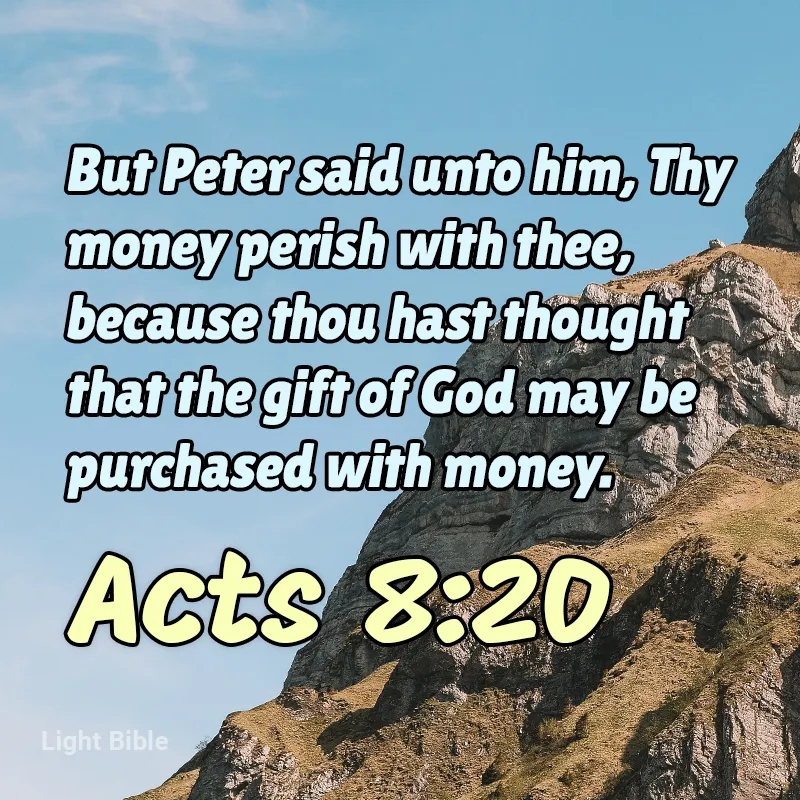
Acts 8:20 (KJV) But Peter said unto him, Thy money perish with thee, because thou hast thought that the gift of God may be purchased with money.

These harsh words indicate how terrible Simon’s sinful desire was. They also show that he had not yet repented, trusted in Christ and been made right with God. True believers will not perish with their money ( John 10 : 28 ), and new believers are not like Simon in the other ways Peter describes him.

Why do we seek God? Simon the Sorcerer thought he could buy the gift of the Holy Spirit, and he got quite the response! His selfish motivation was revealed in his actions. Here’s a way to test our motives: Do we seek to know and do God’s will, or do we hope to bend Him to our will ? If we desire God simply because of what we hope to gain in this life, it’s time to reexamine our motives.

COMMAND TO THE RICH

1 Timothy 6:17-19 (KJV) Charge them that are rich in this world, that they be not highminded, nor trust in uncertain riches, but in the living God, who giveth us richly all things to enjoy;
That they do good, that they be rich in good works, ready to distribute, willing to communicate;
Laying up in store for themselves a good foundation against the time to come, that they may lay hold on eternal life.

It is possible for rich people to fall into the error of thinking that they have no need of God.

“Uncertain riches” God can take away from men whatever He has allowed them to get. Such a result is fitting for those who have stray from God.

“Gives us richly” God is not greedy nor does he hold tightly to whatever He has. Our hope and trust should be in Him, not in people or in the material things which we see with our eyes.

“To enjoy” God wants us to enjoy what He has given to us and He does not want us to think it is wrong for us to enjoy them.

“Rich in good deeds”– We have true spiritual riches. Those who use their riches only for themselves are actually throwing them away.

“Share”– what we do now, what we give now has a profound influence on our eternal future. It is a very sad thing that many people who could do much good with their money selfishly use it only for themselves or spend it for nothing of real value.

God has entrusted some of us with great riches. And it’s often too easy to look at a comfortable home or a big bank account and lose sight of the Giver behind it. Still, all wealth is only with us for a short time and can be gone in an instant. Only God, who gives us all things, is worthy of our trust.

BOOK OF GENESIS

Title:
In the original Hebrew manuscripts of the Old Testament there were no names or titles to the various books. The Jews, to whom God gave His Word, usually called each book by the first one or two words of the opening sentence. In Genesis the first word in Hebrew, the original language of the Old Testament, was the word translated “In the beginning”, and so that is what the Jews called it. Many centuries later Jewish scholars translated the Old Testament into the Greek language and gave names to each of the books. This translation is called the Septuagint. Much later these names were used in the Latin translation of the Bible, and many centuries after that in the English translation of the Bible. In this way the names came into what is now called the King James Version and other English versions.

Author:
The people of Israel from the time of Moses onward were sure that Moses wrote the first five books of the Bible, and there is strong evidence in the Bible itself to support this belief. See Ex 17:14; 24:4; 34:27; Num 33:2; Deut 31:19, 24-26; Josh 1:8; 8:31; 1 Kings 2:3; Luke 24:44; 1 Cor 9:9. Most importantly, Jesus Christ Himself said that Moses wrote about Him. See Matt 19:8; John 5:46-47; 7:19.

Date:
Probably sometime between 1446 and 1406 before Christ.

Theme:
Beginnings. Here we have the beginning of God’s written revelation of Himself, the beginning of the world, of mankind, of sin, of language, of God’s plan of redemption, of the various races of men, and the beginning of the people of Israel through whom God gave His Word.

Contents:
Creation of the heavens and earth 1:1-31
More information about creation 2:1-25
The fall of man into sin and the result 3:1-24
Cain and Abel 4:1-18
The character of Cain’s descendants 4:19-24
Genealogy of early people 5:1-32 Noah, the ark, and the great flood 6:1—8:22
God’s covenant with Noah 9:1-17
The beginning of nations 9:18—10:32
The tower of Babel 11:1-9
More genealogies 11:10-32
Abraham obeys God’s call 12:1-9
Abraham in Egypt 12:10-20
Abraham and Lot separate 13:1-18
Abraham saves Lot 14:1-17
Abraham and Melchizedek 14:18-20 God’s promises to Abraham 15:1-19
The birth of Ishmael 16:1-15
Circumcision commanded 17:1-14
Isaac promised 17:15-19
Abraham’s three visitors from heaven 18:1-15
Abraham prays for Sodom 18:16-33
The destruction of Sodom 19:1-29
Lot and his daughters 19:30-38
Abraham and Abimelech 20:1-18
The birth of Isaac, departure of Ishmael 21:1-21
God tests Abraham about Isaac 22:1-19
Sarah’s death and burial 23:1-20
A bride for Isaac 24:1-67
Abraham’s death 25:1-11
Ishmael’s descendants 25:12-18
Birth of Jacob and Esau 25:19-26
Esau sells his birthright to Jacob 25:27-34
Isaac and Abimelech 26:1-33
Jacob deceives Isaac, gets his blessing 27:1-29
Esau’s loss and anger 27:30-45
Jacob flees to Laban 28:1-22
Jacob’s dream of a ladder 28:10-22
Jacob’s wives and children 29:1—30:24
Jacob and Laban – two deceivers 30:25-43
Jacob flees, Laban pursues 31:1-55
Jacob prepares to meet Esau 32:1-21
Jacob wrestles with the angel 32:22-32
Jacob meets Esau 33:1-17
Jacob at Shechem 34:1-31
Jacob at Bethel 35:1-15
Death of Rachel and Isaac 35:16-29
Genealogy of Esau 36:1-43
Joseph’s dreams 37:1-11
Joseph’s brothers sell him 37:12-36
Judah and Tamar 38:1-30
Joseph in Egypt 39:1—50:26
Potiphar’s wife 39:1-19
Joseph in prison, interprets dreams 39:20—40:23
Joseph appointed prime minister 41:39-57
Joseph and his brothers 42:1—44:34
Joseph reveals his identity 45:1-15
The brothers bring Jacob to Egypt 45:16—46:34
Jacob meets Pharaoh 47:1-12
Joseph’s acts as prime minister 47:13-31
Jacob blesses Joseph’s sons 48:1-22
Jacob blesses his own sons 49:1-28
Death of Jacob 49:29-33
Joseph’s remaining days in Egypt 50:1-26

Design a site like this with WordPress.com
Get started